Diversity (Lacking) in Tech

Twitter, following in the same steps of Google, Facebook, Yahoo, and other big technology companies, published statistics regarding the diversity of their workforce.
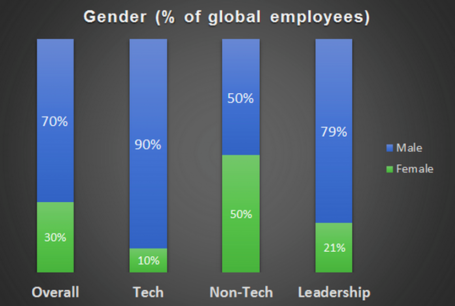
Twitter diversity metrics

As I would have guessed (and have observed in real life), most tech companies are (disproportionately, relative to the ethnic makeup of the United States) comprised of White males, especially in technical fields.  Across the board (at Google, Twitter, Facebook, and Yahoo), only 1-2% of technical roles are filled by Black workers.  One would think that under ideal circumstances, the workforce makeup would somewhat resemble the ethnic makeup of the United States.  There is obviously a gap somewhere, whether it be societal barriers, education, achievement gaps, cultural issues, racism, access to resources, etc. I’m curious, for my Black brothers and sisters in tech that I have met (I do know quite a few), how do they differ, what did they do differently, how was their upbringing different that provided them the opportunity to work in technology, what decisions did they make, what barriers were or were not in their way?  For myself, my path to a software engineering career resembled:

Read more →

AT&T U-Verse Pt. 1 - The Pre-Install

Sooo, I’m getting AT&T’s Uverse package installed at my house in two days and moving from Time Warner Cable.  I am getting television and internet.  I’d thought I’d document this process because I was looking for this same information online and was unable to really find a good article (I found a few) documenting the entire process.  So with that said here we go. Note: AT&T U-Verse is a three-in-one IP solution for digital television, VoIP, and internet services.  The infrastructure is probably way more complicated that I am about to describe.  From what I understand, AT&T runs fiber optic cable to a neighborhood VRAD (Video Ready Access Device) (picture of a VRAD) from a central office.  A VRAD splices the fiber into the copper twisted pair line going to each home.  In order to have access to U-Verse, you must be within 3000 feet of a VRAD.  Outside of this range, service quality diminshes, hence why you are unable to access U-Verse.  This is what they call FTTN (Fiber To The Node).  Verizon FIOS currently runs the fiber optic cable all the way from a central (regional?) location to each customers home.  This is called FTTP (Fiber To The Premises).  As you might imagine, going the FTTP route is very expensive, hence why Verizon has indefinitely suspended new FIOS installations.  However, you do get more throughput over fiber vs. copper.  I think U-Verse tops out around 40Mbps or so over the copper portions of its network whereas FIOS customers can get 50Mbps+ service.  40Mbps is good enough to provide the ability to surf the internet at up to 24Mbps/1Mbps download/upload and watch/record 2HD and 2SD shows at a time. The Pre-Install AT&T came out today and checked the phone line running into the NID (network interface device, where a phone company terminates its connection, and the customer begins) and the NID itself.  I looked at it some time ago and it looked like it was added when the house was built in 1971…lol.  So they replaced it.  They replaced the cable (which was just regular untwisted 4 conductor phone cable) with twisted pair CAT5 cable since VDSL (Very high bitrate Digital Suscriber Line) requires twisted pair.  They also removed the NID from the back of the house and added a new NID right next to the NID for Time Warner Cable.
Read more →
x